
Seeking Sasquatch
A journey to the North American Bigfoot Center

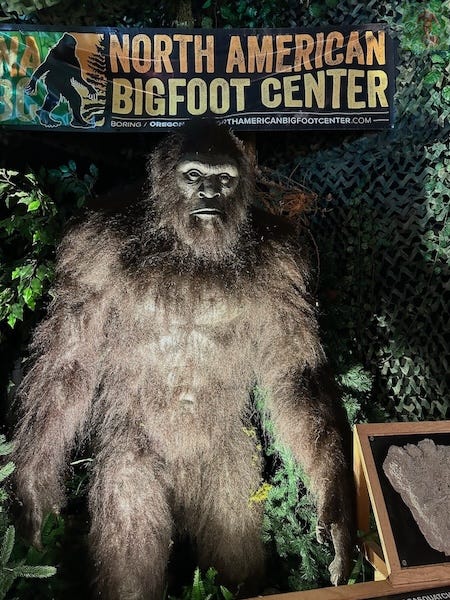
Walk into many towns in the Pacific Northwest and you’ll see images of a giant, fur-covered creature with huge, hairy feet. Congratulations! You’ve encountered Bigfoot, the legendary beast that roams our forests. He appears to be half-man, half-ape.
Bigfoot—aka Sasquatch—is everywhere in the Northwest, decorating t-shirts, stickers, signs, hats, and mugs (even our airport shops offer Bigfoot displays). The kitsch is easy to spot, but what about Bigfoot in the wild? Let’s head to “the dullest town in Oregon” to discover the latest in cryptozoology research.1


Hello, curious readers! This is a post to enjoy with an open mind. There’s a VIP (Very Important Poll) at the end, and no doubt the comments will be interesting. Ready?
Who or What is Bigfoot?
Here in the Pacific Northwest, nearly everyone has an opinion about Bigfoot—and it’s usually different. I’ve heard people talking about Sasquatch as:
Mythical. Stealthy. Secretive.
A shapeshifter.
Scary and threatening. Dangerous.
Fake. Pure imagination.
A terrifying beast.
Hairy. Smelly.
A gentle giant.
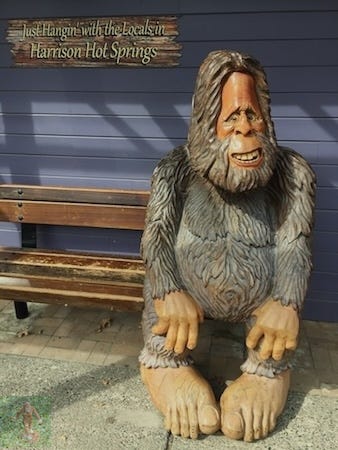
Although sightings of similar “large, hairy creatures” have been reported across the U.S. and Canada—and in countries around the globe—people in the Pacific Northwest take Bigfoot seriously. And I mean, seriously.
Bigfoot Museums Galore
In Cascadia (the bioregion encompassing the west coast of the United States and Canada), we have several museums dedicated to this elusive forest beast. I personally know of four—one in British Columbia, and three in the United States: in Washington, Oregon, and northern California.
Pacific Northwesterners study Bigfoot, track Bigfoot, search for evidence of Bigfoot, discuss Bigfoot, and sometimes fear Bigfoot. But if you’re looking for the science behind this phenomenon, there’s no better place to explore than the North American Bigfoot Center.2
This center—founded in 2019 by Sasquatch expert Cliff Barackman—claims to have the “largest collection of cast evidence in the world.”3 Having visited, I believe it.
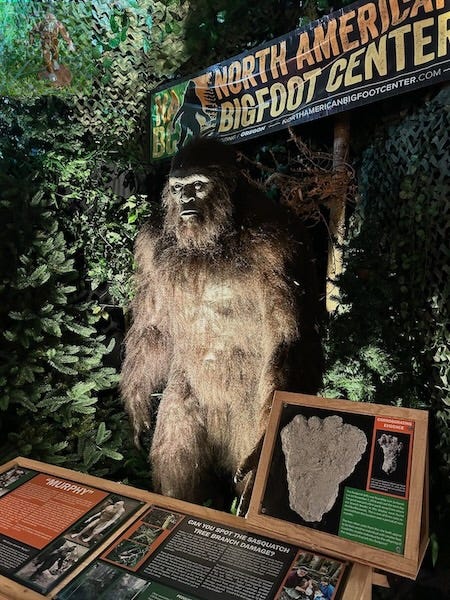
Cliff Barackman is well-known in the field, a researcher who’s spent decades seeking and collecting evidence of Sasquatch. According to his biography4, he’s studied Bigfoot since 1994, traveling across the U.S. and five continents to conduct research. And he was an investigator on Animal Planet’s show, Finding Bigfoot, which aired nearly 100 episodes from 2011-2018.5
We’ll tour the Bigfoot Center in a moment, but first: Why the Pacific Northwest?
Why the Pacific Northwest?
People here embrace Bigfoot. Perhaps it’s because we offer prime habitat—acres upon acres of remote, pristine evergreen forests. Perhaps it’s because we allow Bigfoot sightings to turn from local lore into accepted local history.


And who doesn’t love big, furry animals? Several Northwest sports teams have adopted Bigfoot or Sasquatch as mascots, including:
Squatch of the former Seattle SuperSonics
Douglas Fur of the Portland Trail Blazers
Legend the Bigfoot, 2022 World Athletic Championships (Eugene, OR)
Bigfoot Football Club, a United Soccer League team from Maple Valley, WA.6
Schools have joined the party. The Spokane Colleges recently updated their logo from Bigfoot to Sasquatch (apparently big feet didn’t poll well with students).7 Their mascot’s named Skitch.
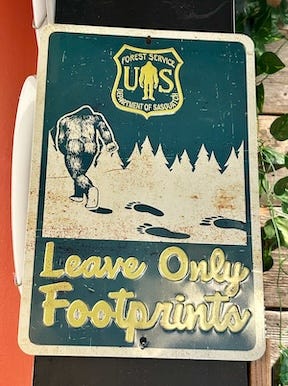
Sadly, the U.S. government seems to be purging references to Sasquatch (lots of 404 errors) but the creature used to ask hikers and backpackers to “Leave no trace”—and I did find one quirky post about habitat loss.8
Regardless of the reasons behind the Northwest’s passion for Bigfoot, it sometimes leads to deadly results. In December of 2024, two men went hunting for Bigfoot in the Gifford Pinchot National Forest and lost their lives, likely from winter exposure.9
When I read articles about this tragic event, several mentioned Cliff Barackman—and that’s how I discovered the North American Bigfoot Center.
So on a rainy day in February, I headed out to Boring, bringing along my husband (a real scientist)10 for skeptical balance.
Boring, you ask?


Boring, Oregon is a small town outside of Portland, named after a man whose name was William Boring.11 And yes, it is the butt of many jokes.

Now that we have Boring out of the way, let’s start our tour!
Inside the NABC
The North American Bigfoot Center looks rather wild from the outside, but how can you resist a place labeled, “Where science and cryptids collide”?


Indoors, it’s a treasure trove of Bigfoot evidence, history, scientific analysis, local lore, and fun. The displays are thoughtful, and they definitely take a scientific perspective.
You’ve probably seen or heard of casts made from Bigfoot prints. But the NABC also offers buttocks prints, knuckle prints, and hand prints—along with multiple footprints, accompanied by detailed analyses of the foot’s unique shape and structure.
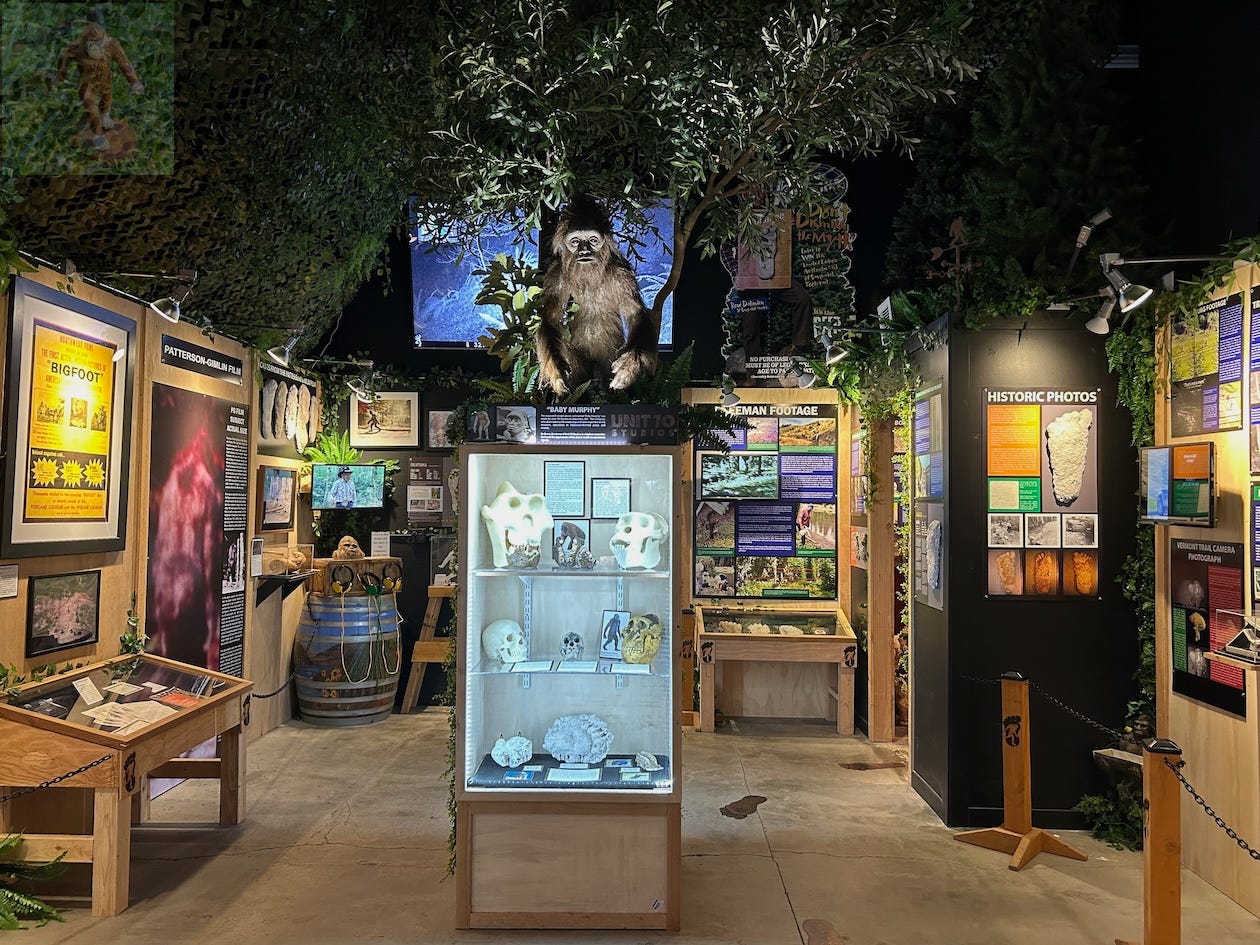
The museum has several rooms and multi-media displays. For the full experience, you have to go in person. But here are some highlights from my visit:
The multi-cultural, historical approach. I’d heard the Chinook word Skookum, and the Algonquian Wendigo—but hadn’t realized that similar creatures have been described and reported all over the world, going back centuries. Examples include the Yeti (Himalayas), Yeren (China), Yowie (Australia)12, and Orang Pendek (Sumatra). The museum also covers how Bigfoot has been presented in movies and stories, such as Teddy Roosevelt’s write-up of the Bauman incident.13
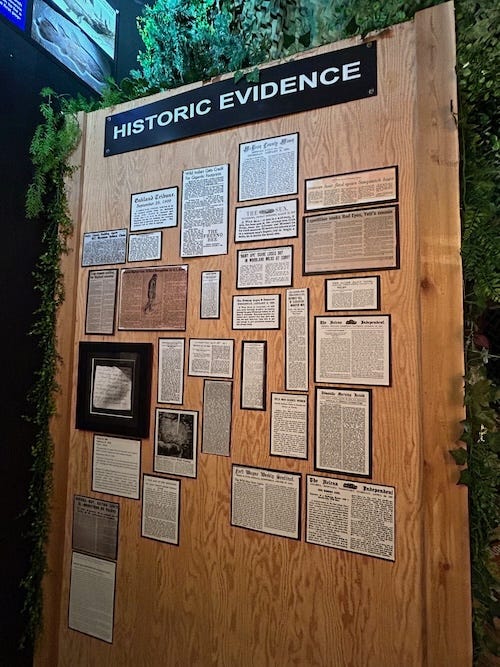
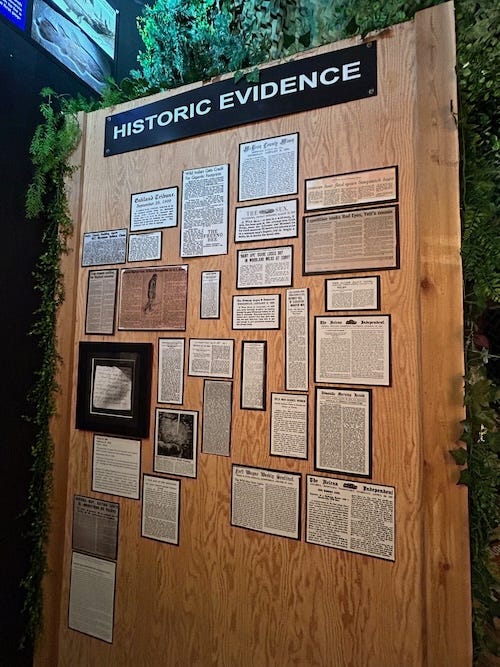
Most displays were colorful and high-tech, but this was just the facts, ma’am.
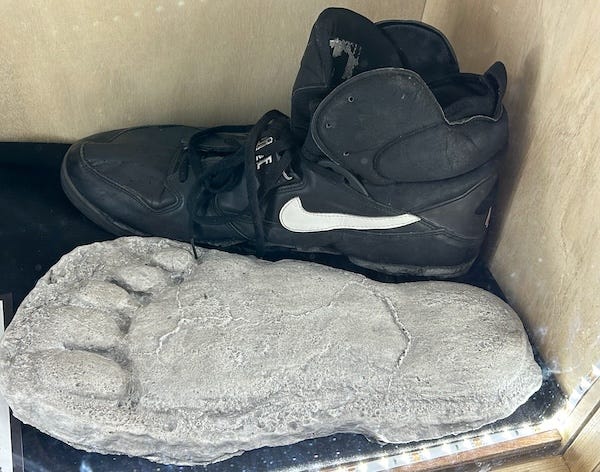
Scientific details, including how to tell the difference between a footprint made by an actual Bigfoot—and one made by someone trying to make you think it’s Bigfoot. (The assessment involves gauging the foot’s width, length, toes, depth of step, and midfoot flexibility). Another exhibit offered hair analysis, comparing hair structures from bears, humans, chimpanzees, and “unknown.” I appreciated that the science was presented in an easy-to-understand way, using lots of visuals and comparisons. For example, seeing this cast next to a size 22 shoe (made for Shaquille O’Neal) helps me visualize that Bigfoot’s print is longer and much wider than any human foot.
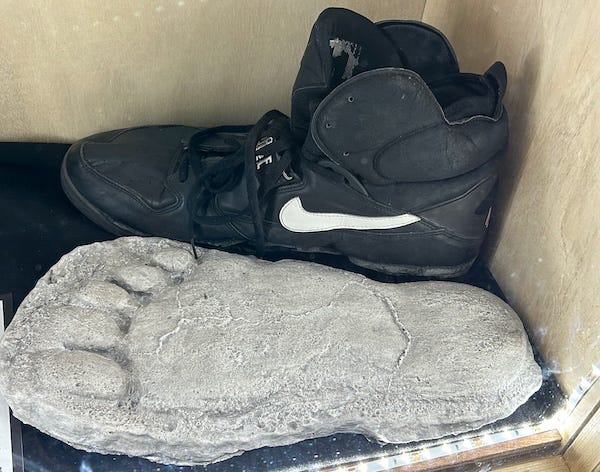
Shaq’s size 22 pales next to Bigfoot The museum expanded my understanding of Bigfoot behavior. I’d heard that Sasquatches liked to bang rocks and throw rocks, but I didn’t know they twisted trees or could leave behind gifts, such as old baseballs. And I certainly didn’t know they were tall enough to climb on roofs or would press their faces against sliding-glass doors, leaving smears behind. (That thought will haunt my next writing retreat at an isolated cabin in the woods. Yikes!)
The NABC offers rich details about Bigfoot, including sounds (vocalizations), scent, their activities and habitat (hotspots appear to be the Olympic Peninsula and the Gifford Pinchot forest, both in Washington), and nesting behavior. There was a fascinating display on how several giant nests were discovered that could’ve been created by Bigfoot, and how the discovery delayed logging plans until an investigation had been completed.
(To hear sound recordings, head over to cliffbarackman.com.)
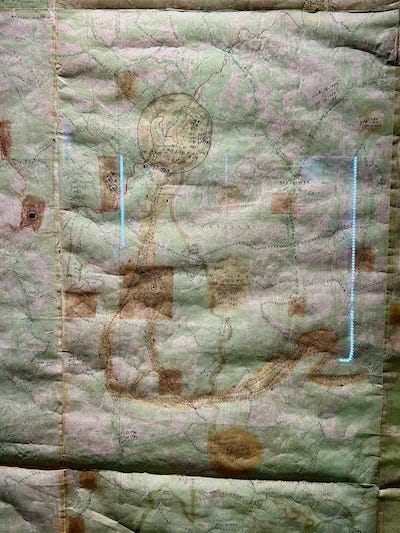
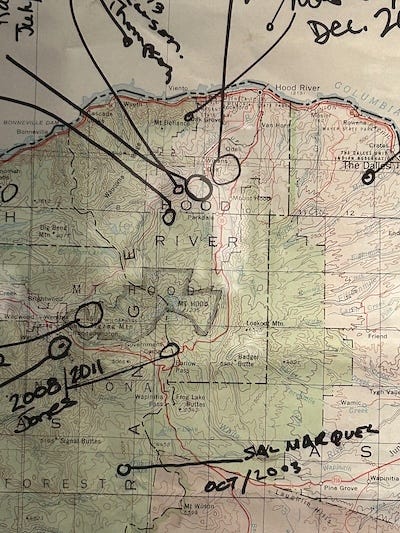
Topo maps used in research The NABC was created by true Bigfoot believers, but it doesn’t shy away from hoaxes or skeptics. There’s one display entitled “If Sasquatches are real, where are the bones?” and another called “Hoaxed Footprints.” You can choose to believe in Bigfoot—or not—but the evidence is there for your perusal. (And hey, if footprints don’t sway you…there are buttocks prints.)
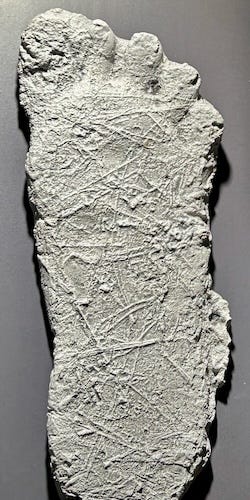
Not a hoax foot! This is a Bigfoot cast from a display.


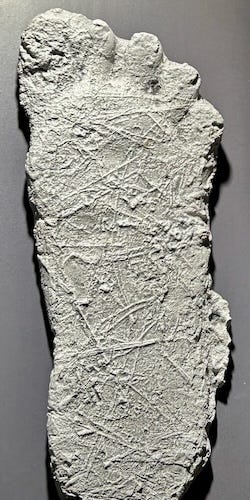
Videos and documentaries. Several displays included videos purporting to show Bigfoot, including Paul Freeman’s film. I enjoyed the opportunity to watch and assess these recordings with my own eyes. The museum also played a short documentary, an interview of a man who reported seeing Bigfoot when driving home at night. Quite interesting! (Other documentaries are available as a perk of museum membership. For about the same cost as a Substack subscription, you can watch Barackman’s Bigfoot films from the comfort of your couch.)
Fascinating links to local history. I’d heard of Ape Cave and Ape Canyon, by Mt. St. Helens in Washington. But I had no idea that the “Ape” came from a Sasquatch encounter. Apparently, back in 1924, five miners had their cabin attacked by Bigfoot—but they lived to tell the tale.14 According to a NABC display, descendants of these miners recently located the cabin site and mine entrance, which many assumed had been buried by the eruption of Mt. St. Helens in 1980.
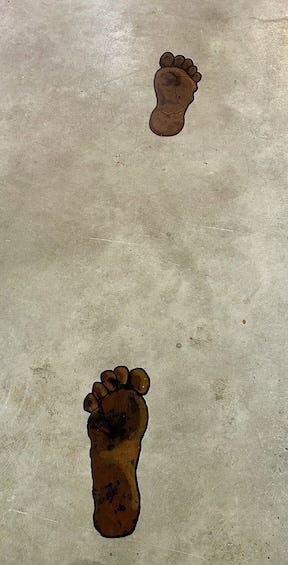
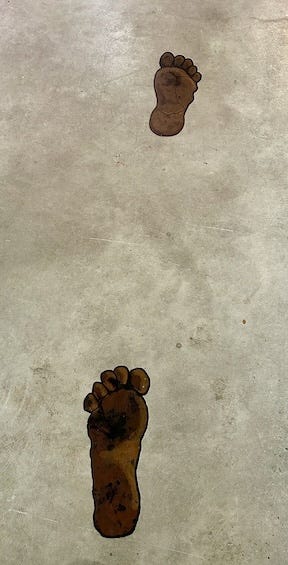
And finally, the wowing number of government staff who got tangled up in Bigfoot sightings, either by reporting one themselves or by being asked to investigate other people’s reports. We’re talking foresters, fish and wildlife professionals, US/Canada border patrol agents, and county sheriffs. It makes sense—many worked in deeply wooded areas—but it still surprised me.
Should we believe in Bigfoot?
We all hold different levels of skepticism and belief, and that’s cool. I won’t say exactly where I fall on the spectrum…but offer you these thoughts:
Many interesting phenomena have resisted being captured in photographs (think ghosts, UFOs, and auras). Does this mean they don’t exist? Is Sasquatch in this category?
Jane Goodall, the esteemed gorilla researcher, believes in Bigfoot—at least partly. According to Wikipedia, citing NPR and Huffpost,15 her comments on the matter have ranged from “…you will be amazed when I tell you that I’m sure they exist” to “I’m a romantic, so I always wanted [them to exist]” to “…why isn’t there a body? I can’t answer that, and maybe they don’t exist, but I want them to.” [P.S. I met Jane Goodall in person once. She knows her stuff! And she was very nice. I’d trust what she says on this matter.]
Perhaps Bigfoot is a “you gotta see it to believe it” wonder. But while you wait for your own personal sighting, check out Cliff Barackman’s website and the NABC. You won’t be sorry!
I left the museum with some cute souvenirs (PNW socks and Baby Squatch) as well as much to ponder. If you’d like to visit, admission is a reasonable $8 per person.
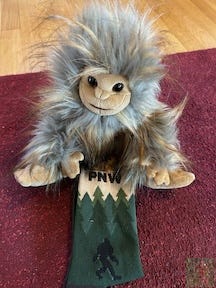
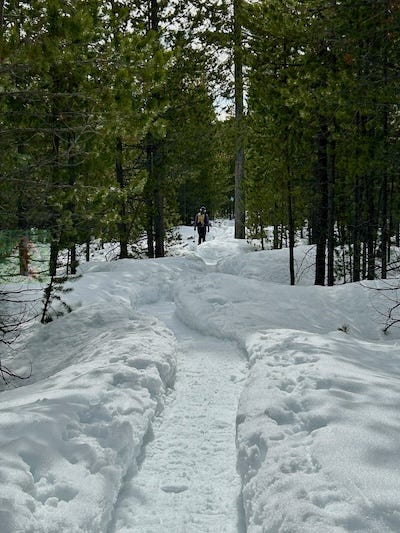
Seeing the exhibits definitely brought Bigfoot to the forefront of my mind. When we ventured into the forest the next weekend to go snowshoeing, I found myself peering around for Sasquatch. Though I have no sighting to report—alas—it reminded me that many creatures, big and small, live in the woods. They depend on healthy forests for their existence—and they depend on us to keep these forests thriving.
Public Service Announcement: If you need to report a Bigfoot sighting, you can do so through the NABC webpage form.
And now for a VERY IMPORTANT POLL:
FYI, once we have at least 15-20 responses, I’ll disclose poll results in a Note.
Thank you for supporting my writing and Whispering Waters! If you enjoyed reading this post, Likes, Shares, Restacks, and Comments are always appreciated.
Up Next at Whispering Waters
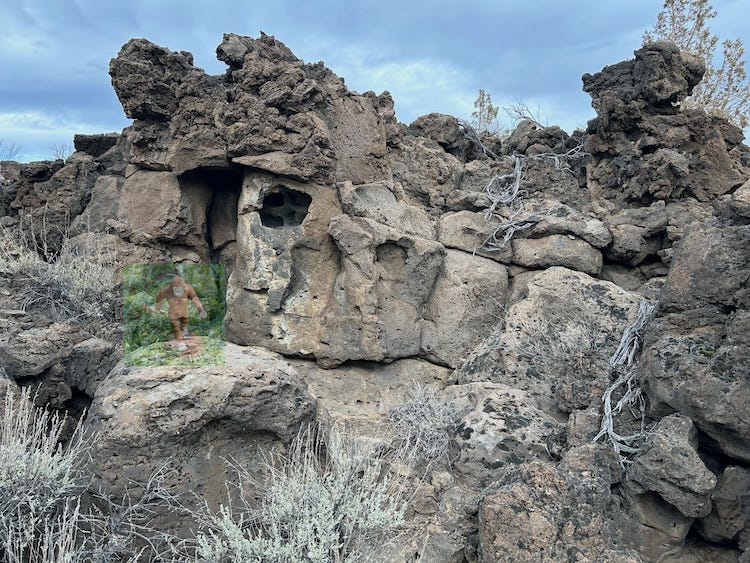
Hiking the Oregon High Desert. We’ll venture to the bad part of town, where the trees are twisted and the rattlesnakes roam. Stay tuned—that’s coming in March!
All photos are by Christine Finlayson, copyright 2025. Photos taken inside the museum were included in this post with the permission of the NABC.
Footnotes:
https://cryptozoologymuseum.com/what-is-cryptozoology/
https://northamericanbigfootcenter.com (Or if you’re in Canada, check out the museum at Harrison Hot Springs)
cliffbarackman.com
Ditto.
Ditto.
https://en.wikipedia.org/wiki/Bigfoot AND https://www.uslleaguetwo.com/news_article/show/1324355
https://shared.spokane.edu/Content-Items/News-Articles/2025/Spokane-Colleges-Launches-Rebrand-Kick-off-Planned?s=CCS
https://www.usda.gov/about-usda/news/blog/loss-space-threatening-north-american-sasquatch
https://www.wweek.com/outdoors/2024/12/31/the-founder-of-the-north-american-bigfoot-center-urges-caution-when-going-into-the-woods-in-winter/
Technically, I’m a real scientist, too, given the B.S. and M.S. But I’m mostly interested in how scientific info is used and communicated. These days, I consider myself more of a writer than a scientist.
https://en.wikipedia.org/wiki/Boring,_Oregon
This Yowie link was provided by a kind subscriber: https://www.yowiehunters.com.au/
https://squatchable.com/article.asp?id=14878
http://www.bigfootencounters.com/classics/beck.html
Wikipedia link is at 6. NPR link: https://www.npr.org/2006/11/10/6469070/sasquatch-legend-meets-science AND https://www.huffpost.com/entry/jane-goodall-bigfoot_n_1927876
Christine,
As a "believer" and subscriber to Cliff's "Beyond Bigfoot, With Cliff & Bobo" podcast and lifelong enthusiast of "it's more fun to believe", I thank you for your snark free, unbiased, informative, and somewhat educational treatment of the subject and the NABC. If you personally, or any of your regular readers are interested in a well balanced intro to the bigfoot/sasquatch subject I would steer you to Laura Krantz's Wild Thing podcast. She's a credible staff journalist of NPR as well as a relation of a pioneering figure in biology and primate research, Grover Krantz. https://www.foxtopus.ink/wildthing-bigfoot
Thanks again for the interesting read and break from my chemistry homework ;)
Rob
Very nice article. I live in Ohio but hope to visit the NABC in the very near future. I have been interested in the topic since 1968 when I received material from a manangement employee at the Toledo Zoo. I have always felt the sightings fell into three categories. The first are the obvious hoaxers, which are plentiful. The second grouping falls into simply misidentified spieces and the third category consists of actual sightings by many reputable individuals who have nothing to gain and the possibility of their reputations diminished. Footprints, visual sightings, unidentified hair and DNA samples are readily available.
The Native American cultures from all over North America have included Sasquatch in their customs handed down from generations. They are included in many ceremonies and on their Totem, which also included other animals native to their habitat. These were animals they came in contact with, not folklore and they all exist today. Why would they make up a "phantom" animal? They have dozens of different names for this creature throughout the individual tribes.
So yes, I believe they exist. From the thousands of sightings through the decades, it only takes one for the species to exist.